
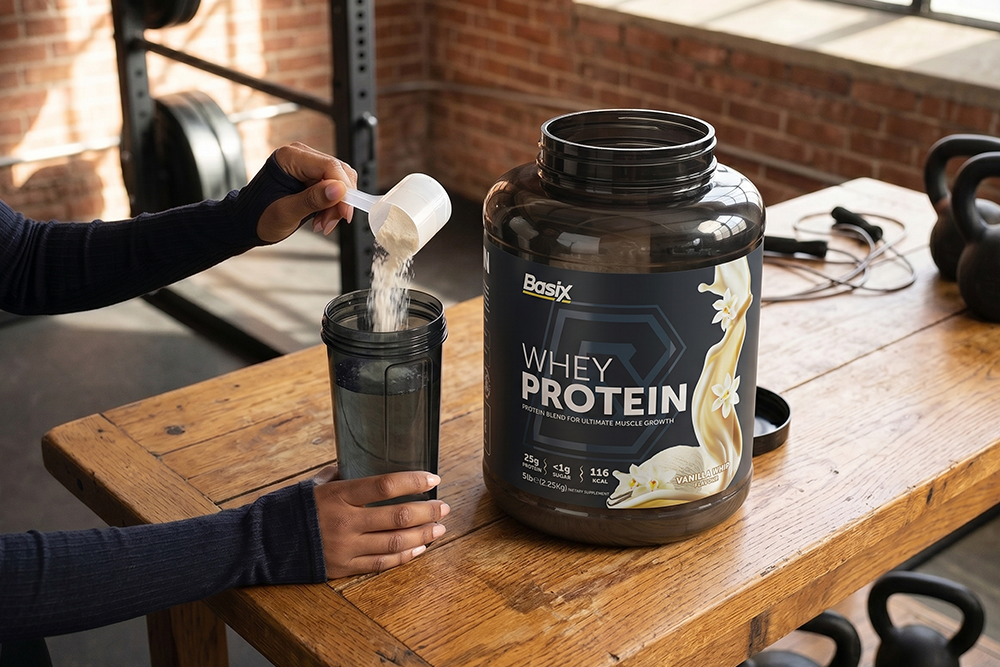
Introduction to Whey Protein
Walk into any gym or health store and it won’t take long before you spot rows of whey protein tubs lining the shelves. It’s one of the best-selling supplements in the world—and it’s not hard to see why. Whether you’re trying to build muscle, recover faster, or simply hit your daily protein targets without eating chicken at every meal, whey protein delivers.
But with so many options out there: concentrates, isolates, hydrolysates. It can get confusing fast. This guide cuts through the noise and gives you everything you need to know about whey protein: what it is, what it does, and how to choose the right one for your goals.
What Is Whey Protein?
Whey protein comes from milk. When milk is processed to make cheese, it separates into two proteins: casein (the curds, about 80%) and whey (the watery liquid left behind, about 20%). That liquid whey is then filtered, processed, and dried into the powder you scoop into your shaker.
Even though whey is the smaller fraction of milk protein, it’s incredibly nutrient-dense, packing roughly 55% of the total nutrients from the original milk into a much smaller package.
At its core, whey is made up of several proteins, the main ones being beta-lactoglobulin and alpha-lactalbumin. It’s also naturally rich in sulfur-containing amino acids like cysteine and methionine, which are key for producing glutathione, one of the body’s most powerful antioxidants.
Types of Whey Protein
Not all whey protein is the same. The way it’s processed determines the protein concentration and how your body uses it. Here’s what you need to know:
Whey Protein Concentrate (WPC)
The most popular and affordable option. WPC typically contains between 70 and 80% protein by weight, with small amounts of fat and lactose still present. It has a great taste and texture and still holds onto some of the beneficial bioactive compounds like immunoglobulins. If you’re after a solid everyday protein without breaking the bank, WPC is your go-to.
Whey Protein Isolate (WPI)
WPI goes through extra filtering to reach 90%+ protein content, almost all the fat and lactose gets stripped away. That makes it ideal if you’re watching calories closely or if you’re lactose intolerant. It’s also the better choice if you want a cleaner mix in protein shakes and drinks. Comparing whey concentrate vs. isolate? Concentrate is a great all-around value; isolate is the premium, lean option.
Whey Protein Hydrolysate (WPH)
This one is essentially pre-digested. The protein chains are broken down into smaller pieces, so your body absorbs them even faster. It’s commonly used in clinical nutrition and infant formulas because it’s very easy on the digestive system. The trade-off? It tends to taste bitter. You’ll usually find it blended with other proteins or heavily flavored to mask that.
Native Whey Protein
A newer category, produced directly from fresh milk rather than as a cheese byproduct. It has a very clean protein structure and a higher leucine content. Less common and pricier, but gaining traction among athletes who want the purest form available.
Nutritional Value of Whey Protein
Whey is a complete protein meaning it contains all nine essential amino acids your body can’t produce on its own. But what really sets it apart is its amino acid quality and how fast your body can use them.
Whey consistently scores at the very top of every protein quality measure used in nutrition science. Its biological value (BV) sits at around 104 higher than whole eggs or beef. Using the newer DIAAS scoring system (which measures how well your small intestine actually absorbs each amino acid), high-quality whey isolates score above 1.0, outperforming soy and pea proteins.
The real star of the show? Leucine. Whey contains roughly 13.6% leucine, far more than plant proteins like soy (8%) or wheat (6.8%). Leucine is the key trigger for muscle protein synthesis. Think of it as the switch that tells your muscles to start growing and repairing. Whey hits that threshold with a smaller dose than most alternatives.
Whey also provides useful amounts of calcium, magnesium, phosphorus, zinc, and B vitamins. So it’s not just a one-trick protein punch.
Key Benefits of Whey Protein
Builds muscle & supports recovery
This is the big one. Whey protein for muscle growth is backed by decades of solid research. Its fast digestion means amino acids hit your bloodstream quickly after training, exactly when your muscles need them most. Studies have consistently shown that people supplementing with whey gain significantly more lean muscle than those using soy or carbohydrate supplements. One major nine-month trial found the whey group gained nearly double the lean mass compared to the soy group.
It also speeds up recovery by reducing markers of muscle damage and easing soreness after hard sessions.
Helps with weight management
Protein in general has a high thermic effect; your body burns more calories just processing it. But whey goes a step further by triggering satiety hormones that make you feel full for longer and curbing the hunger hormone ghrelin. Clinical research has shown that adding whey to your diet can lead to meaningful reductions in body fat, especially around the waist, without sacrificing muscle.
Supports your immune system
The bioactive components in whey, particularly lactoferrin and immunoglobulins have antimicrobial properties. Pair that with whey’s role in boosting glutathione (your body’s main antioxidant), and you’ve got a supplement that does more than just fuel your workouts. For athletes training hard, immune support matters.
Who Should Use Whey Protein?
The short answer? Almost everyone can benefit. Here’s a quick breakdown:
- Athletes & gym-goers: Hitting your daily protein targets (1.4 – 2.0 g per kg of bodyweight) is essential for performance and recovery. Whey is one of the most practical ways to do that.
- Older adults: As we age, muscles become more resistant to protein. Whey’s high leucine content makes it one of the most effective tools to fight age-related muscle loss (sarcopenia) and stay strong.
- People managing their weight: whey keeps hunger in check and preserves muscle while you’re in a calorie deficit, a winning combination.
- Those with lactose sensitivity: WPI and WPH contain very little lactose and are well tolerated by most people who struggle with regular dairy.
- Anyone who struggles to eat enough protein: not everyone can hit their protein goals through food alone. Whey makes it easy and convenient.
How to Choose the Right Whey Protein
The supplement market is huge, and unfortunately, not every product is what it claims to be. Here’s what to look out for when you’re buying:
Watch out for amino spiking
Some brands add cheap free-form amino acids (like glycine or taurine) to artificially inflate the protein reading. The result? You think you’re getting 25g of quality protein per scoop, but a good chunk of it won’t actually help you build muscle. Check the ingredient list; if you see glycine, taurine, or creatine listed alongside the protein with no separate breakdown, that’s a red flag.
Consider heavy metal content
Research has found that a significant percentage of protein powders contain trace heavy metals. Chocolate-flavored varieties tend to be worse for this. Opting for vanilla or unflavored products from reputable brands is a sensible move.
Look for third-party certification
If you compete in sport or just want peace of mind, look for products certified by NSF Certified for Sport, Informed Choice, or BSCG. These programs independently test for banned substances, label accuracy, and purity.
How to Use Whey Protein
How much should you take?
Research points to 20 – 40g per serving as the sweet spot for stimulating muscle protein synthesis that provides around 2.5 – 3g of leucine, which is the threshold needed to trigger muscle growth. More than that in one sitting doesn’t speed things up; your body simply burns the extra amino acids for energy instead.
When should you take it?
Post-workout (within two hours) is a great time because your muscles are primed to absorb nutrients. That said, total daily protein intake matters more than timing. Aim to spread your protein across the day, roughly every 3 – 4 hours, to keep your muscles in a positive building state.
It’s not just for shakes
Whey is surprisingly versatile in the kitchen. Stir it into porridge or Greek yogurt, bake it into pancakes or protein balls, or blend it into smoothies. Unflavored WPI can even be whisked into soups or scrambled eggs if you need to boost your protein without changing the taste.
Potential Side Effects & Safety
Whey protein has an excellent safety record for healthy adults. But let’s address some common concerns:
Does it damage your kidneys?
No, not in healthy individuals. The idea that high protein intake harms kidneys is a myth that has been repeatedly disproved in research. The exception is people who already have kidney disease (stage 3 or above), who should always manage protein intake under medical guidance.
Does it cause acne?
Some people, particularly younger men, notice a flare-up in acne with high whey intake. This is thought to be linked to IGF-1 and insulin responses that can increase sebum production. If this affects you, it’s worth trying a plant-based protein alternative for a period and seeing if things improve.
What about bloating and gas?
This is almost always down to lactose intolerance rather than the protein itself. Switching to WPI or WPH, both very low in lactose, usually sorts the problem.
Whey Protein vs Other Protein Sources
Whey vs. casein
Both come from milk, but they work differently. Whey digests quickly and gives you a sharp spike in amino acids, ideal post-workout. Casein forms a slow-digesting gel in the stomach, making it better suited to taking before bed to keep your muscles fed overnight.
Whey vs. soy
Soy is the only plant protein that’s considered “complete,” but it still comes up short compared to whey in terms of muscle building. Its lower leucine content and the way it directs amino acids away from muscle tissue mean you generally need more soy protein to get the same result. That said, soy does have its own benefits: cardiovascular and bone health among them. So it’s a solid choice for those who can’t or don’t want to use dairy-based protein.
Whey vs. pea & rice
Pea and rice proteins are popular plant-based alternatives. Pea is low in methionine; rice is low in lysine. Blend the two together and you get a more complete profile, though you’ll still typically need a larger serving to match whey’s leucine content. For muscle building, whey remains the gold standard. But for vegans or those with dairy allergies, a good pea/rice blend is a legitimate runner-up.
Final Thoughts
Whey protein earns its place at the top of the supplement ladder. The science is clear: it’s the most effective protein source for building muscle, supporting recovery, and helping you stay on track with your nutrition goals, whether you’re training five days a week or just getting started.
The key is choosing a quality product. Look for transparent labeling, third-party testing, and no shortcuts. At Basix Nutrition, that’s exactly what we build everything around, pure, simple, effective ingredients with no hassle and no complications.